低氧工作站在敲除OLFM4/HIF1α減少非小細胞肺癌的低氧誘導損傷的應用
 圖1:西班牙肝臟和消化系統疾病網絡生物醫學研究中心在EBioMedicine發表文獻
工作站及氣體使用情況:Invivo2 400,低氧(1% O2),常氧(5%CO2,95%空氣)
文章主要內容:OLFM4 參與增殖、分化、侵襲、凋亡和細胞粘附等多種細胞活動,而在NSCLC
中,HIF-1α因子也參與了細胞內多種反應,包括耐藥、增殖和侵襲。本研究發現,在低氧條件下,HIF-1α可以調控 OLFM4 蛋白,且
NSCLC 細胞中OLFM4 的缺失可阻斷癌細胞的侵襲及加速癌細胞對順鉑藥物的敏感性,證明OLFM4 是化療耐藥的關鍵調控因子,提示 OLFM4
/HIF-1α軸可作為一種很有前途的 NSCLC 治療靶點,沉默OLFM4 可用于克服缺氧誘導的順鉑耐藥性。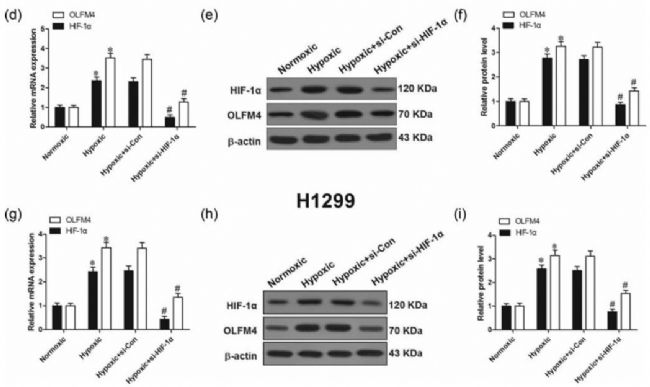 圖2:Expression
of OLFM4 is upregulated in NSCLC cell lines. (d, g) RT‐PCR was applied
to measure the expression of OLFM4 and HIF‐1α in hypoxic A549 (d) and
H1299 (g) cells. (e, f, h, i) Western blot assay was conducted to
determine the protein expression of OLFM4 and HIF‐1α in A549 (e, f) and
H1299 (h, i) cells under
the hypoxic condition. Data represent the mean ± SD of three independent experiments.
與常氧(20.9% O2)條件相比,缺氧(1% O2)環境下非小細胞肺癌(A549 和
H1299) 細胞中的 OLFM4 和 HIF‐1αmRNA (d,g)及蛋白表達(f,i)水平均顯著增加。敲除 HIF‐1α基因后,隨著
HIF‐1 基因與蛋白表達的減弱,OLFM4 基因與蛋白的表達也明顯降低(f,g,i),表明 OLFM4 由 HIF‐1α調控。
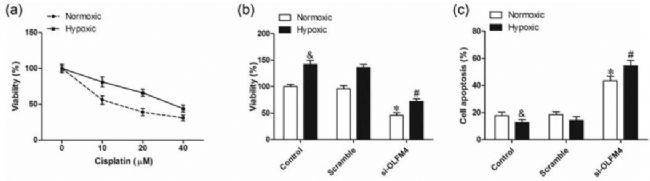 圖3: Depletion
of OLFM4 enhances the drug sensitivity of cisplatin under hypoxia. (a)
A549 cells were treated with different dosages of cisplatin for 24 hr
under normoxia or hypoxia. Cell viabilities were measured by the MTT
assay. A549 cells were treated with 20 μM cisplatin for 24 hr under
normoxia or hypoxia. (b) Cell viabilities
were monitored by MTT assay. (c) Cell apoptosis was evaluated using ELISA‐based Cell Death Detection
ELISAPLUS Kit. (d–f) The protein expression levels of MDR1 and caspase 3 were determined using western blot assay.
與常氧(20.9% O2)條件相比,A549 細胞在低氧(1% O2)環境下對順鉑藥物表現出較高的耐藥性。敲除 OLFM4 基因后,缺氧條件下 A549 細胞不僅對順鉑的敏感性增強(細胞生存能力降低),凋亡速度也明顯加快。