
A Reliable Millimeter-Wave Quadrature Interferometer
M. Gilmore, W. Gekelman, K. Reiling, and W.A. Peebles
Institute of Plasma and Fusion Research, University of California, Los Angeles, California 90024
A
simple, low-cost millimeter-wave (70 GHz) interferometer with a phase
accuracy better than ± 2 degrees, and a response time of 10 ns is
described. The simplicity of this interferometer makes it ideal for
measurement of electron densities in laboratory or semiconductor
processing plasmas. The relative high accuracy and low cost are attained
by a homodyne system with a quadrature intermediate frequency (IF)
mixer, now commercially available in millimeter-wave frequency bands.
The design and construction of magnetic shielding for the system
isolator, which may be required around magnetically-confined plasmas, is
also described.
1. INTRODUCTION
Although Langmuir probes are able to measure normalized density profiles, they are unreliable for determining absolute density in the presence of strong (B > 500 Gauss) magnetic fields. Comparison of the density from either the electron or ion saturation currents can be a factor of three lower than densities derived from wave dispersion. In applications where the absolute density needs to be known an alternative technique must be employed. The measurement of wave dispersion is time consuming, however microwave interferometry can be an attractive alternative.
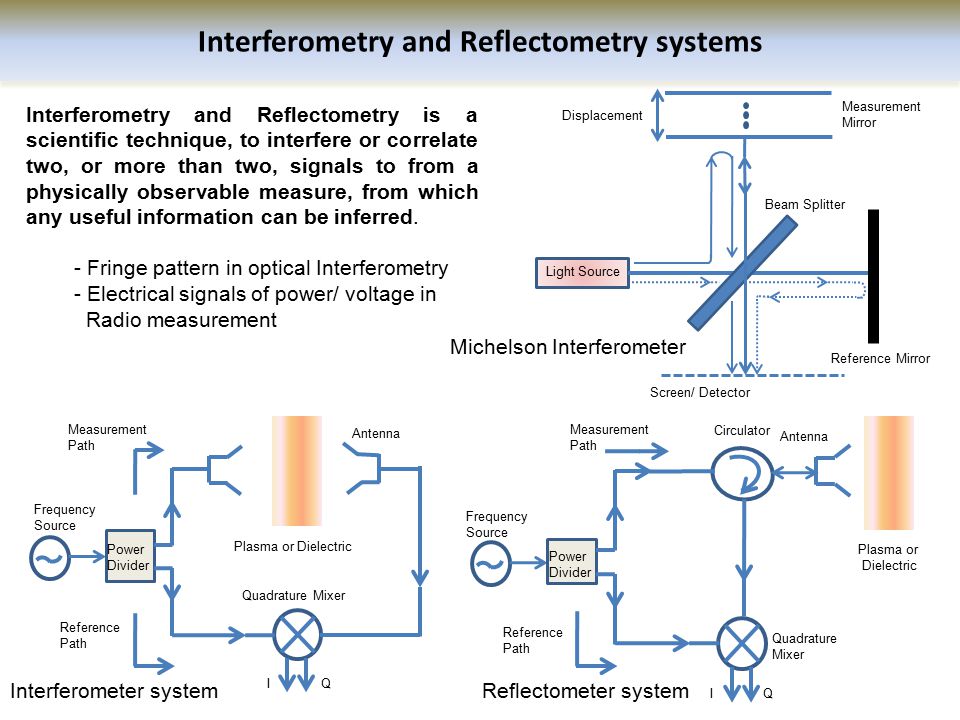
Many interferometry applications, such as the measurement of electron densities ne = 1017-1018 m-3 in plasmas ranging in size from a few centimeters (cm) to many tens of cm, are best handled at millimeter-wave frequencies. Typically, millimeter-wave interferometers have been either rather low resolution homodyne systems, more complicated frequency modulated homodyne systems [1], or high resolution heterodyne systems which are relatively expensive to construct [2]. In unmodulated homodyne systems utilizing a mixer with a single IF output, the output voltage is VIF = Acos(theta) Here A is the amplitude and q is the phase angle between the radio frequency (RF) and local oscillator (LO) inputs. Generally VIF is a function of both phase angle and RF power. Thus, there is ambiguity between amplitude and phase changes, and the user must resort to counting the number of 2 pi phase shifts (fringes), and estimating fractions of a fringe. Additionally, there is no information available from the interferometer as to whether the phase difference is increasing or decreasing. This can be a problem, for example, in plasmas that initially increase in density, and drop before reaching steady state.
The problems of amplitude-phase ambiguity and phase uncertainty can be solved by frequency modulation (FM) of the source of a homodyne interferometer. A changing plasma density appears as a time varying phase shift in the IF signal. While effective, this approach adds to the complexity and cost of the system, and can potentially add phase noise and drifts. In addition, the frequency response of the instrument is limited by the modulation frequency ( f = 1 MHz).
A
simple solution to the problems encountered in these type of homodyne
instruments, without resorting to a heterodyne system, is to generate
two IF outputs in phase quadrature, VIF1 = Asin(theta) and VIF2 = Acos(theta). One output can then be divided by the second, yielding a result containing phase information only.
VIF1/VIF2 = tan(theta) (1)
Although other designs are possible [3],[4], the most direct way to generate phase quadrature outputs is to use a commercially available quadrature IF mixer. A description of the implementation and operating characteristics of a 70 GHz quadrature homodyne system utilizing a packaged quadrature mixer is the subject of this paper. This system combines high sensitivity with fast time response, superior to that of an FM homodyne system, at low cost. In addition, the simplicity of the instrument provides a high level of reliability.
近日,電子科技大學自動化工程學院研究團隊在期刊《神經網絡》上發表研究性論文。該文首次提出毫米波近場透視成像與可見光的圖像融合方法。隨著目標檢測技術的快速發展,多種傳感器在提升檢測精度方面發揮著關鍵作用......
現代信息社會中,移動通信是實現信息高效流動的基本手段。近期,第五代移動通信系統(5G)已實現大規模商用。當前,5G長期演進和第六代移動通信系統(6G)成為學術界和產業界的研究熱點。實現高通量無線通信的......
毫米波(名詞解釋?)與太赫茲波(名詞解釋?)探測技術在通信、安全、生物檢測、頻譜分析等領域有著廣泛的應用。它們是將承載著毫米波與太赫茲波的光信息轉變為電信號的核心技術。高靈敏度、寬波段、快速響應及面陣......
近日,由中國科學院沈陽自動化研究所團隊與以色列魏茨曼科學院(WeizmannInstituteofScience)研究團隊,聯合提出了針對多輸入多輸出(Multiple-InputMultiple-O......
在時間某處,也許就是此刻新一代的技術變革正激發全新理念的誕生作為未來科技的推動者我們幫助從事前沿研究的高校、公司、研究機構,開啟測量新視野使其產品從概念到商用,速度更快科技的迅猛發展帶來了很多新的變化......
今日推薦文章作者為東南大學毫米波國家重點實驗室主任、IEEEFellow著名毫米波專家洪偉教授,本文選自《毫米波與太赫茲技術》,發表于《中國科學:信息科學》2016年第46卷第8期——《信息科學與技術......
對于投資者來說,軍民融合一直是雙創中一個重要的領域,由高校實驗室走出的項目往往具有高精尖等特點。但是另一方面,這些項目往往都是軍轉民,而且項目長期處于高校之中難以發現。為了提高科技成果轉化,支撐產業發......
由北京航空航天大學承擔的“新能源汽車”重點專項“電動汽車智能輔助駕駛關鍵技術研究與產品開發”項目“智能輔助駕駛環境感知關鍵技術研究與產品開發”課題研究取得階段性成果。課題重點圍繞77GHz毫米波雷達關......
分析測試百科網訊2017年2月23日,國家重大科學儀器設備開發專項“毫米波成像探測儀研制及產業化示范”項目(2012YQ140037)初步驗收會在同方威視密云基地召開。國家科技部資源配置司副司長吳學梯......
意大利電信近日宣布成立一個毫米波(mmWave)頻段實驗室,用于研究毫米波在5G網絡中的應用。意大利電信是歐洲第一家開設毫米波實驗室的電信運營商。這個位于都靈的實驗室包括遠場緊湊天線測試系統和球面近場......