
原文地址:http://news.sciencenet.cn/htmlnews/2024/3/519334.shtm
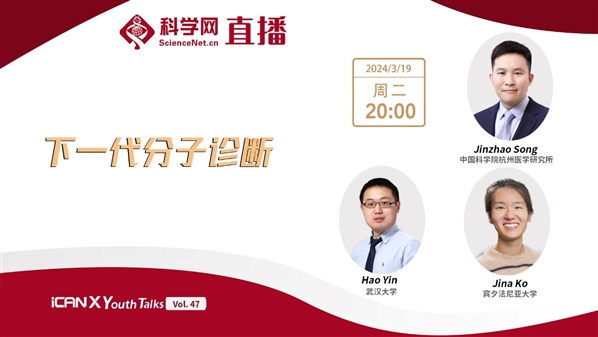
直播時間:2024年3月19日(周二)20:00-22:00
直播平臺:

科學網APP
(科學網微博直播間鏈接)

科學網微博

科學網視頻號
北京時間3月19日晚八點,iCANX Youth Talks第四十七期邀請到了中國科學院杭州醫學研究所Jinzhao Song、武漢大學Hao Yin、賓夕法尼亞大學Jina Ko三位教授主講,北京大學張海霞教授擔任主持人,期待你一起加入這場知識盛宴。
【嘉賓介紹】

Jinzhao Song
中國科學院杭州醫學研究所
Smartphone-based Mobile Detection Platform for Molecular Diagnostics: from Infectious Diseases to Cancer
【Abstract】
Rapid, quantitative molecular diagnostics in the field, at home, and in resource poor settings is needed for evidence-based disease management, control, and prevention. Conventional molecular diagnostics requires extensive sample preparation, sophisticated instruments, and trained personnel, restricting their use to centralized laboratories. To overcome the limitations of laboratory-based procedures, we designed a series of simple, inexpensive, hand-held, smartphone-based mobile detection platforms, for rapid, connected, and quantitative detection of pathogens’ nucleic acids. We anticipate that our methods will improve quality of health care in regions lacking sophisticated laboratories and enable patients to assume greater responsibility for their care.
Moreover, we have been expanding our technology platform to incorporate the detection of rare cancer biomarkers in body fluids, enabling cancer screening, individualized therapy, and minimal residual disease (MRD) detection. To overcome the challenge of identifying very low concentrations of mutant alleles within a large background of very similar wild type nucleic acids, we utilize programmable endonucleases, including Argonaute and CRISPR-Cas systems, to selectively cleave wild type alleles in the course of nucleic acid amplification, yielding a significantly improved signal-to-noise ratio.
在野外、家中以及資源匱乏的環境中,我們需要進行快速、定量的分子診斷,以便為基于證據的疾病管理、控制和預防提供支持。傳統的分子診斷方法需要復雜的樣本制備、精密的儀器和訓練有素的人員,這限制了它們在中央實驗室的應用。為了克服實驗室操作方法的局限性,我們設計了一系列簡單、經濟、手持式的智能手機移動檢測平臺,用于快速、聯網和定量檢測病原體的核酸。我們預計我們的方法將改善缺乏精密實驗室的地區的醫療保健質量,并使患者能夠承擔更大的護理責任。
此外,我們一直在拓展我們的技術平臺,以納入對體液中罕見癌癥生物標志物的檢測,從而實現癌癥篩查、個體化治療和微量殘留病(MRD)檢測。為了克服在大量非常相似的野生型核酸背景下識別極低濃度的突變等位基因的挑戰,我們利用可編程核酸內切酶,包括Argonaute和CRISPR-Cas系統,在核酸擴增過程中選擇性切割野生型等位基因,從而顯著提高信噪比。
【BIOGRAPHY】
Jinzhao Song is a Professor at the Hangzhou Institute of Medicine (HIM), Chinese Academy of Sciences, Zhejiang Cancer Hospital. Prior to this role, he served as a Research Assistant Professor at the University of Pennsylvania, School of Engineering and Applied Science. Dr. Song received his Ph.D. from the Institute of Chemistry, Chinese Academy of Sciences (ICCAS). With over 15 years of experience, he has focused on developing next generation molecular diagnostic systems based on isothermal nucleic acid amplification; microfluidic chip that utilize smartphones for detection, analysis, result recording and sharing; and programmable enzymes such as Argonaute and CRISPR-Cas proteins. He has co-authored 51 peer-reviewed papers with H-index 23, 15 of which he was the lead author, and was named as co-inventor in 9 granted patents and 10 patent applications. Dr. Song is a recipient of the NIH K01 Research Scientist Development Award, as well as a PI/co-PI of an R21 NIH grant and two venture incubation programs. His contributions to the field of molecular diagnostics earned him the AACCs "2019 Young Investigator Award for Outstanding Research in Personalized Medicine." Additionally, Dr. Song founded EzDx Technology Inc., an enterprise dedicated to the commercialization and widespread adoption of these cutting-edge diagnostic tools, thereby setting a new standard in healthcare diagnostics and personalized medicine.
Jinzhao Song是中國科學院杭州醫學研究所、浙江省腫瘤醫院的一名教授。在此之前,他曾擔任賓夕法尼亞大學工程與應用科學學院的研究助理教授。宋教授在中國科學院化學研究所獲得了博士學位。擁有超過15年的經驗,他主要致力于開發基于等溫核酸擴增的新一代分子診斷系統;利用智能手機進行檢測、分析、結果記錄和分享的微流控芯片;以及可編程酶,如Argonaute和CRISPR-Cas蛋白。
宋教授共撰寫了51篇經過同行評審的論文,H指數為23,其中15篇為第一作者,并作為共同發明人獲得了9項已授權專利和10項專利申請。宋教授榮獲了NIH K01研究科學家發展獎,并擔任了R21 NIH資助項目以及兩項創業孵化項目的主要或共同負責人。他在分子診斷領域的貢獻為他贏得了美國臨床化學家協會(AACC)頒發的“2019年個性化醫學杰出研究青年研究者獎”。
此外,宋教授還創立了EzDx科技有限公司,致力于將這些前沿診斷工具商業化并廣泛推廣,從而在醫療保健診斷和個性化醫學領域樹立新的標準。
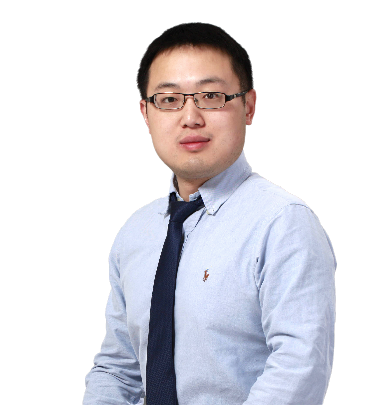
Hao Yin
武漢大學
Rapid detection of pathogens based on CRISPR technology
【ABSTRACT】
Despite the great potential of CRISPR-based detection, it has not been competitive with other market diagnostics for on-site and in-home testing. We dissect the rate-limiting factors that undermine the performance of Cas12a-, Cas12b- and Cas13a-mediated detection. In one-pot testing, Cas effectors interferes with isothermal amplification by binding to and cleaving the amplicon, or directly degrades the target RNA. We used suboptimal protospacer adjacent motifs (PAM) of Cas12a to enhance the flexibility, speed, sensitivity, and reproducibility of one-pot testing. Moreover, we found that the PAM-interacting domain engineered Cas12b accelerated one-pot testing with 10–10,000-fold improved sensitivity. In parallel, by diminishing the interference of Cas13a with viral RNA, the optimized Cas13a-based assay detected 86 out of 87 SARS-CoV-2 clinical samples at room temperature in 30 minutes with a sensitivity of 0.5 cp μl−1, equal to optimized RT-qPCR assay. The relaxed reaction conditions and improved performance of CRISPR-based assays make them competitive for widespread use in pathogen detection.
盡管CRISPR檢測具有巨大應用潛力,但在臨床和家庭自檢方面與其他市場診斷產品相比,在性能方面尚不具競爭力。我們分析了限制Cas12a、Cas12b和Cas13a介導檢測性能的限速因素。在一步法測試中,Cas蛋白通過結合并切割底物,或直接降解靶標RNA的方式干擾了等溫擴增,從而使檢測整體性能下降。我們利用Cas12a 的非經典PAM序列來提高一步法測試的靈活性、速度、靈敏度和可重復性。此外,我們發現通過工程化Cas12b的PAM相互作用結構域,可以將一步法測試的速度提高10–10,000倍,并提高靈敏度。與此同時,通過減少Cas13a對病毒RNA的干擾,優化的Cas13a檢測方法可在室溫條件下在30分鐘內檢測到87個SARS-CoV-2臨床樣本中的86個,靈敏度為0.5 cp μl−1,和優化好的RT-qPCR方法相當。這些高性能的檢測方法使CRISPR在病原體檢測中具備競爭力和轉化能力。
【BIOGRAPHY】
Hao Yin is a Professor at the Medical Research Institute and Frontier Science Centre for Immunology and Metabolism of Wuhan University. He was selected for the National High-level Talent Youth Program. He completed his undergraduate studies at Nanjing University and obtained his Ph.D. from the University of Colorado Medical Campus in 2010. From 2010 to 2016, he worked as a postdoctoral fellow at the Massachusetts Institute of Technology (MIT), followed by a position as a scientist at Vertex Pharmaceuticals from 2016 to 2018. Since February 2018, he has been leading a research team at Wuhan University. He has published over 50 papers and has been cited more than 10,000 times according to Google Scholar. Ten of his papers have been recognized as highly cited papers, and his research achievements have been covered by mainstream international media and reviewed in Nature series journals. Since joining Wuhan University, his team has focused on gene editing and RNA therapy, developing efficient diagnostic technologies for diseases using CRISPR and new editing methods for site-specific insertion. He has published multiple papers as corresponding author, including in Nature Biomedical Engineering (2020, 2022, 2023), Nature Methods (2022), and Nature Chemical Biology (2024).
殷昊為武漢大學醫學研究院和教育部“珠峰計劃”免疫和代謝前沿科學中心教授、博士生導師。本科畢業于南京大學,2010年在美國科羅拉多大學醫學中心獲博士學位,2010-2016年在美國麻省理工學院任博士后,2016-2018在美國福泰制藥任研究員,2018年2月起在武漢大學建立研究團隊。已在國際刊物發表和接收論文50余篇,被引用約10000余次 (google scholar),10篇論文入選高被引論文,多項研究成果被國際主流媒體報道和Nature系列雜志專文評述。入職武漢大學以來,殷昊團隊聚焦基因編輯和RNA療法,研發了CRISPR對疾病進行高效診斷技術, 新型基因組定點插入方法等。以通訊作者發表多篇論文,包括 Nature Biomedical Engineering (2020, 2022, 2023),Nature Methods (2022) , Nature Chemical Biology (2024) 等。

Jina Ko
賓夕法尼亞大學
Single Biomarker Profiling for Medical Diagnostics
【ABSTRACT】
Due to an inherent biological heterogeneity across individuals and within a disease, it is extremely challenging to identify robust biomarkers that can accurately represent molecular status of the body for disease diagnostics. To solve this intractable problem, we have developed microfluidic platforms and molecular tools that enable high throughput, multiplexed profiling of biomarkers (e.g. cells, extracellular vesicles; EV). We achieved high throughput profiling by combining sequencing with parallelization of microchip technologies and droplet microfluidics. We overcame the variability of any individual biomarker between individual patients, by developing tools that can measure multiple markers and we applied machine learning to identify signatures that persist across this variability. To resolve cell and EV heterogeneity, we have recently developed an ultra-fast cycling method for single cell analysis and an ultra-high sensitive microfluidics that can achieve single particle detection sensitivity, enabling individual EV measurements.
由于個體間以及疾病內部的固有生物學異質性,識別能夠準確代表身體分子狀態以用于疾病診斷的穩健生物標志物極具挑戰性。為了解決這一棘手問題,我們開發了微流控平臺和分子工具,能夠進行高通量、多重生物標志物分析(例如細胞、細胞外囊泡;EV)。我們通過將測序與微芯片技術的并行化以及液滴微流控技術相結合,實現了高通量分析。我們開發了能夠測量多個標記物的工具,克服了不同患者之間任何單一生物標志物的變異性,并應用機器學習來識別這些變異性中持續存在的特征。為了解析細胞和EV的異質性,我們最近開發了一種用于單細胞分析的超快速循環方法,以及一種超高靈敏度的微流控技術,可以實現單粒子檢測靈敏度,從而能夠對單個EV進行測量。
【BIOGRAPHY】
Jina Ko is an Assistant Professor in the Departments of Pathology and Laboratory Medicine and Bioengineering at University of Pennsylvania. She focuses on developing single molecule detection from single extracellular vesicles (EV) and multiplexed molecular profiling to better diagnose diseases and monitor treatment efficacy. Jina graduated from Rice University with a B.S. in Bioengineering and a B.A. in French Studies in 2013 and she earned her Ph.D. in Bioengineering at the University of Pennsylvania in 2018. During her Ph.D., she developed machine learning-based microchip diagnostics that can detect blood-based biomarkers to diagnose pancreatic cancer and traumatic brain injury. For her postdoctoral training, she worked at Massachusetts General Hospital and the Wyss Institute at Harvard University as a Schmidt Science Fellow and a NIH K99/R00 award recipient. Jina developed new methods to profile single cells and single EV with high throughput and multiplexing.
Jina Ko是賓夕法尼亞大學病理學、實驗醫學與生物工程系的助理教授。她專注于開發單細胞外囊泡(EV)的單分子檢測技術和多重分子分析技術,以更好地診斷疾病和監測治療效果。Jina于2013年畢業于萊斯大學,獲得生物工程學士學位和法國研究學士學位,并于2018年在賓夕法尼亞大學獲得生物工程博士學位。在攻讀博士學位期間,她開發了基于機器學習的微芯片診斷技術,該技術能夠檢測血液中的生物標志物,以診斷胰腺癌和創傷性腦損傷。在博士后培訓期間,她作為施密特科學研究員和NIH K99/R00獎獲得者,在麻省總醫院和哈佛大學的懷斯研究所工作。金娜開發了高通量、多重分析的新方法,用于分析單個細胞和單個EV。
【主持人】
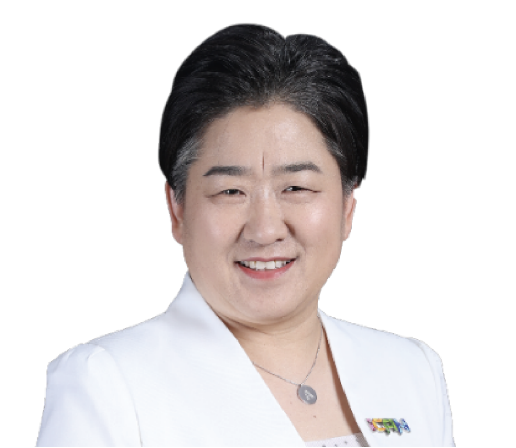
Haixia Zhang
山西大學智能信息處理研究所團隊在圖神經網絡研究方面取得重要進展,相關成果5月23日發表于人工智能領域國際期刊《IEEE模式分析與機器智能學報》(IEEETransactionsonPatternAna......
原文地址:http://news.sciencenet.cn/htmlnews/2024/10/531421.shtm10月11日,科幻電影《749局》科影融合特別場在京舉行。電影主創團隊與科技領域相......
10月11日,甘肅省迎來了職業教育領域的一個重要里程碑——甘肅林業職業技術大學正式揭牌成立。這一歷史性時刻標志著歷經六十八載發展的甘肅省唯一一所林業類高等院校,正式邁入了本科教育的新階段,開啟了新的征......
”標志性科考活動獲系列重大突破 “第二次青藏科考標志性科考活動守護水塔‘一原兩湖三江’科考主體任務已經基本完成,這次科考從天到地、從冰到水取得了全方位的進展。”第二次青藏科考隊隊長、中國科學......
關于確定2024年國家環境健康管理試點名單的通知北京市、河北省、內蒙古自治區、遼寧省、黑龍江省、江蘇省、浙江省、江西省、山東省、湖北省、湖南省、廣東省、重慶市、四川省、貴州省、陜西省、青海省生態環境廳......
10月8日,華中農業大學果蔬園藝作物種質創新與利用全國重點實驗室、藥用植物資源可持續利用團隊梅之南教授和楊慶勇教授課題組,發布了首個專門面向菊科植物的多組學數據庫平臺——AsteraceaeMulti......
實驗桌上堆放著精密儀器和焊接工具,電腦上是正在運行的電路圖,一頁頁寫滿了數據、畫滿了圖樣的紙張在桌面鋪開,各式或大或小的電子元件前,南京郵電大學工程實驗教學部創新中心副主任郝學元正在埋首研制電工電子實......
近日,記者從中國計量大學獲悉,該校生命科學學院蜜蜂與蜂產品學研究團隊主持的兩項推薦性國家標準《GB/T44349-2024 蜂花粉總多酚的檢測福林酚試劑比色法》和《GB/T44350-202......
10月10日,由廣東省機械行業協會組織并主持召開的“面向軟性物料的多級賦碼追溯柔性包裝生產線研制與應用”項目科技成果鑒定會議在廣東佛山舉行。經專家鑒定,該項目成果總體技術水平達到國際先進水平。記者獲悉......
近日,中國熱帶農業科學院橡膠研究所組培與轉基因團隊在全球率先獲得了橡膠樹CRISPR/Cas9純合基因編輯橡膠苗。相關研究成果在線發表于《經濟作物和產品》(IndustrialCropsandProd......