
Most RNA isolation techniques currently in use have been developed for the processing of large quantities of material. These typically involve multiple phenol extractions (Reinert et al. 1981 Mol. Cell Biol. 1:829-836) or guanadinium isothio-cyanate/cesium chloride gradients (Chirgwin et al. 1979 Biochem 18:5294-5299) and can be both expensive and time consuming. Often, however, needs arise where quantitatively smaller amounts of RNA are needed from many different samples, for example, during time series analyses or when screening transfor-mants for expression of a transformed gene. Under such circumstances, existing tech-niques are overly time consuming and yield more RNA than is necessary. The availability of a rapid RNA mini-prep is thus desirable. Such a system has been developed for isola-ting plant RNA (Nagy et al. 1988 Plant Molecular Biology Manual, B4; ed. Gelvin and Schilperoort, Klewer Academic Publishing, pp. 1-29), and we have adapted this procedure for use with Neurospora and, potentially, other filamentous fungi. Below, we describe the use of this procedure with 50 ml mycelial cultures, although we have used in with equal success with 5 ml cultures without scaling down the amounts of any reagents.
The method involves the use of a triphenylmethane dye, aurintricarboxylic (ATA), to protect the RNA. ATA binds irreversibly to RNA and is a potent inhibitor of most nucleic acid binding enzymes (Hallick et al. 1977 Nucl. Acids Res. 4:3055-3064). Thus, RNA made with procedure cannot be used for in vitro transcription or translation or reverse transcription but works fine for RNA/DNA or RNA/RNA hybridizations.
To minimize RNase contamination, all glassware is baked at 182°C for at minimum of four hours. Work with gloved hands. The procedure is as follows:
1. Conidia from slants (grown in 16 x 150 mm test tubes containing 8 ml of solid medium) are resuspended in 50 ml of Horowitz complete medium (Horowitz 1947 J. Biol. Chem. 171:255-262) and the cultures grown overnight with shaking at 30°C. A 50 ml culture typically yields enough RNA for 200 gel lanes (see below), and, as noted, smaller culture volumes may be used.
2. Flat mycelial pads are easier to grind than mycelial balls. Therefore, filter cultures using a Buchner funnel onto Whatman #44 filter paper. Wrap flat mycelial pads in aluminum foil and freeze in dry ice. Do not freeze in EtOH/dry ice bath because alcohol might seep through foil. Pads can be stored at -70°C for at least three weeks.
3. Wash a mortar and pestle thoroughly with warm water and Alconox (Fisher Scientific); cool by filling with liquid N2. Remove frozen, flat mycelia from foil and add it to the liquid N2 in mortar. Add ~0.5 g of baked sand and grind mycelial pad to a fine powder. Add more N2 as needed. Mortar and pestle should be washed after every sample.
4. Working quickly before powder can thaw, pour or spoon ground mycelia into 15 ml round bottom Sarstedt tube (Sarstedt tubes #60.540, Princeton, NJ) containing 8 ml of E buffer at room temperature. [E buffer: 50 mM Tris-Cl pH 8.0, 300 mM NaCl, 5 mM EDTA, pH 8.0, 2 SDS; autoclave and add 1 mM ATA and 14 mM ?-mercaptoethanol. ATA=aurintricarboxylic acid, ammonium salt (Sigma #A0885, St. Louis, MO)]
5. Thaw the powder in E buffer in 42°C water bath, occasionally shaking, to get SDS into solution. This should take about 5 minutes.
6. Add 1.1 ml of 3M KCl, invert to mix, keep on ice for 10 min. Solution should form semi-solid, flocculent mass as K-SDS precipitate forms.
7. Spin at 3000g, 4°C in a fixed angle rotor. Make sure caps are screwed on tightly to prevent tubes from collapsing.
8. Pass supernatant through 50 micron Miracloth (Calbiochem #475855, La Jolla, CA) in a funnel into fresh Sarstedt tube.
9. Measure volume of average-sized sample. Add 0.5 vol. 8 M LiCl, mix and stand at 4°C overnight.
10. Spin at 12000g, 4°C, for 15 min in a fixed angle rotor. Thoroughly resuspend pellet in 4 ml sterile gd (glass distilled) H2O with pasteur pipette.
11. Extract twice with phenol/chloroform/isoamyl alcohol (25:24:1), spinning 12000g 10 min at 4°C in a fixed angle rotor. Save aqueous (upper) phase; add gd H2O if volume is less than 2 ml.
12. Add 0.1 vol 3M NaOAc pH 6.0, mix and add 2.5 vol EtOH, mix. Place at -20°C overnight or -70°C for 15 min.
13. Spin 12000g, 10 min, 4°C. Wash pellet with 70 EtOH and drain. Pellet should be a light pink or white.
14. Resuspend in 0.4 ml sterile gd H2O in a microfuge tube. Precipitate with NaOAc and EtOH as in step 12.
15. Spin 10-20 min in microfuge. Wash twice with 70 EtOH and dry pellet. Resuspend in 200 μl of sterile RNase-free gd H2O. Store at -70°C for up to three months. Spectophotometric quantification may be done at this point.
16. Load 1 μl onto a formaldehyde gel. Electrophorese overnight at 20 volts. Blot onto nitrocellulose. Probe with DNA fragment of choice. Expose to film.
Yields are typically on the order of 1-2 mg total RNA from an overnight 50 ml culture arising from an average slant. The number of samples able to be processed using this procedure is limited by the number of spaces in a centrifuge rotor. We have done as many as 24 samples in one day, and doing several times this many would be possible. We have observed on ethidium bromide stained gels that the fluorescence from the RNA deriving from this miniprep is brighter than that seen when the corresponding amount of standard-prep RNA is used. This may be due to enhanced fluorescence of RNA in the presence of ATA. However, autoradiography of the blots does not show any RNA degradation products (Figure 1). This procedure would probably work fine with other methods of tissue disruption. ATA inhibits many nucleic acid binding proteins, possibly by competing for binding sites (Blumenthal and Landers 1973. BBRC 55:680-688). Therefore, the most critical factor is getting the RNA in contact with ATA before nucleases can bind to the nucleic acid and degrade it. Supported by federal grants to J.J.L. and J.C.D.
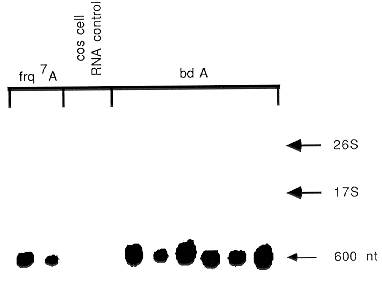
Fig. 1. ATA mini-prep RNA probed with ccg-1 DNA fragment. Total RNA from a series of transformants into bd A and frq7 A was examined for the presence of the ccg-1 gene transcript (Loros et al. 1989 Science 243:385-388). Each lane contains 10 μg of RNA (1/200 of the preparation). While the fluorescence staining of the RNA extended from the 26S to below the 17S RNA bands (not shown), the hybridization revealed the presence of only a single undegraded transcript in each lane containing transformant RNA and no hybridization to the monkey cos cell RNA control.
基因組大片段的精準操控是作物育種和合成生物學領域的關鍵需求。CRISPR-Cas系統依賴DNA雙鏈斷裂(DSB),大片段重排效率低且易產生副產物。經典重組酶識別序列固定、無法重新編程。近年,bridg......
近日,中山大學腫瘤防治中心主任醫師牟永告團隊聯合廣東省科學院生物與醫學工程研究所醫學材料團隊郭會龍副研究員等科研人員,開發出一種三重響應型可注射水凝膠,可在術后瘤腔實現siRNA靶向遞送,從而阻斷腫瘤......
近日,中國農業科學院植物保護研究所聯合多家科研單位,成功研發出以RNA干擾為核心的根結線蟲綠色防控技術,相關研究成果發表在《現代農業化學》(AdvancedAgrochem)上。根結線蟲是嚴重危害糧食......
美國弗吉尼亞理工大學科學家團隊開發出一種名為“RNAbpFlow”的AI模型,在RNA結構預測任務中的表現可媲美谷歌旗下“深度思維”公司開發的“阿爾法折疊3”,且無需依賴海量進化序列數據庫,有望加速R......
近日,中國農業科學院作物科學研究所野生稻保護與利用創新研究組聯合國內外科研團隊系統解析了水稻長鏈非編碼RNA的多組學特征與表型效應,揭示了其驅動表型變異與育種潛力。相關研究成果發表在《細胞研究》(Ce......
中國科學院動物研究所研究員趙方慶團隊開發基于納米孔RNA直接測序技術與深度學習策略的RNA修飾圖譜解析算法ORCA。相關研究發表于《自然-通訊》。基于深度學習的RNA修飾系統識別與注釋模型 ......
現代生命離不開三樣東西:DNA、蛋白質和RNA。但問題是,它們不可能同時出現。蛋白質就像建筑工人和建筑材料,沒有蛋白質,DNA無法復制;DNA就像建筑藍圖,沒有DNA,蛋白質無法構建。為了解開這個“先......
據27日《自然》雜志報道,英國倫敦大學學院(UCL)化學家通過模擬早期地球的條件,首次實現了RNA與氨基酸的化學連接。這一難題自20世紀70年代以來一直困擾著科學家,如今,這一突破性成果為解答生命起源......
美國芝加哥大學團隊開發了一種更為靈敏的液體活檢技術,該方法利用RNA而不是傳統的DNA來檢測癌癥。這一創新方法在使用患者血液樣本進行測試時,識別出早期結直腸癌的準確率達到95%,顯著優于現有的非侵入性......
由新加坡科技研究局基因組研究所領導的科學家團隊,發布了迄今全球最大、最全面的長讀長RNA測序數據集之一——新加坡納米孔表達數據集(SG-NEx)。這一成果有望解決疾病研究中長期存在的技術瓶頸,使研究人......