
We have developed a method for isolating high quality total RNA from N. crassa mycelia that reliably yields large quantities. It is possible to extract more than 50 minipreps at once.
Procedures of RNA extraction published so far follow roughly three different approaches, where phenol/chloroform, guanidinium salts, and/or LiCl is used. However, these protocols have some disadvantages. They are either time consuming, or yield low amounts of RNA, or are not powerful enough for cultures containing high levels of nucleases. Extraction from starved cultures or plate mycelia with the LiCl method (Chambers and Russo, Fungal Genet. Newsl. 1987. 33:22-24) gave completely degraded RNA as judged by gel electrophoresis. In trying to improve the method we modified the protocol used for Chlamydomonas by Gromoff et al. (Mol. Cell. Biol. 1989. 9:3911-3918) who combined the advantages of phenol extraction and LiCl precipitation. The procedure is suitable for rapidly grown mycelia, starved mycelia, mycelia from plates (4 days old) and single colonies of N. crassa grown on a sorbose plate. With this protocol, from 20 to 300 mg (dry weight) of mycelium, grown in liquid media or on plates, yielded between 200 μg and 3 mg of RNA depending on the growth conditions and strains. From a single colony we could isolate up to 5 μg total RNA.
Mycelium from a liquid or surface grown culture was harvested, washed, dried thoroughly with filter paper and frozen in liquid nitrogen. Single colonies including agar were stamped out using an inverted Pasteur pipette and frozen.
The procedure of extraction given below is described for Eppendorf tubes but it is also possible to scale up the volumes. All manipulations were performed at room temperature if not stated otherwise.
- Pulverize the mycelium in a mortar with liquid nitrogen
- Transfer the powder into a mixture of 0.75 ml lysis buffer (0.6 M NaCl, 10 mM EDTA, 100 mM Tris HCl, pH 8.0, 4 SDS) and 0.75 ml phenol (saturated with 0.1 M Tris HCl, pH 8.0) in a 2 ml Eppendorf tube. The tube can be filled with powdered mycelium
- Shake for 15-20 min (Eppendorf Rotationsmischer 3300)
- Centrifuge for 10 min, 10,000 rpm
- Transfer the upper phase into an equal volume of phenol (saturated with 0.1 M Tris HCl, pH 8.0) and vortex
- Centrifuge for 10 min, 10,000 rpm
- Add 0.75 volumes of 8 M LiCl to the upper phase
- Store overnight at 4°C
- Vortex briefly and centrifuge for 10 min, 10,000 rpm
- Resuspend the pellet, which is not always visible, in 0.3 ml double distilled water, mix with 0.03 ml 3 M Na-acetate (pH 5.2) and 0.75 ml ethanol
- Store at -20°C for 2 h or at -70°C for 30 min
- Centrifuge for 10 min, 10,000 rpm
- Discard the supernatant and wash the precipitate with 70 ethanol
- Dry the RNA pellet and redissolve it in DEPC treated (diethyl polycarbonate) water
- Store the RNA solution at -70°C
Purity of the RNA preparations was assayed by spectrophotometric measurements. The A260/A230 and A260/A280 ratios were 2 or more, indicating the absence of any protein or polysaccharide contamination. Usually, traces of DNA present in RNA preparations can be seen in the slots of ethidium bromide stained formaldehyde gels. Based on this criterion, RNA samples prepared by the described method were free from contaminating DNA, while clear nondegraded ribosomal bands were seen in all 200 extractions we made (see Figure 1). Northern blot analysis by hybridization with several 32P-labelled probes (Figure 2) and in vitro translation experiments (Figure 3) have shown clear signals indicating the presence of intact mRNA.
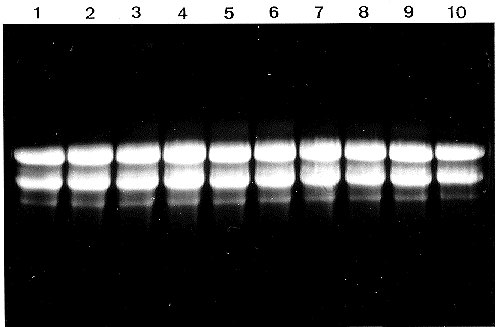
Figure 1. Total RNAs (10 礸 per lane) from 10 different preparations (lanes 1-10) were electrophoresed on a 1.2 agarose gel containing 2 formaldehyde. Visualization was done by staining with ethidium bromide and irradiation with UV. The major bands correspond to 28S and 18S rRNA, faint bands to 23S, 16S and 5S rRNA.
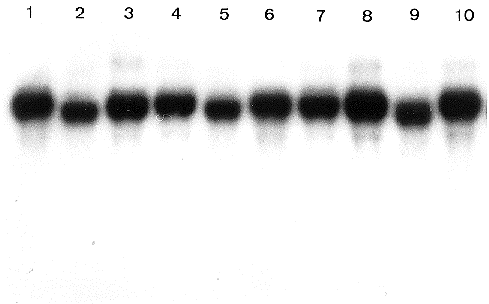
Figure 2. Autoradiogram after Northern blotting and hybridization to 32P-labelled cDNA insert of arbitrarily chosen clone N6 (T. Sommer et al. 1989. Nucl. Acids Research 17:5713-5723). Northern analysis was done according to R.A. Kroczek and E. Siebert 1990. Analyt. Biochem. 184:90-95.
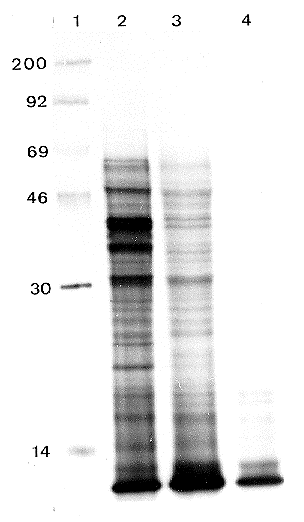
Figure 3. SDS-PAGE (12.5) of 35S-methionine-labelled in vitro translation products. Lane 1: 14C-labelled marker proteins, molecular wieghts are indicated on the left (Mr x 10(-3). Lanes 2 and 3: RNA prepared from mycelia grown in rich or ammonium depleted medium respectively. RNA probes correspond to lanes 1 and 2 in Fig. 1 and 2. Lane 4: control translation without RNA.
Acknowledgements: We thank Beate Otto for in vitro translation experiments and Niketan Pandit for critically reading the manuscript.
近日,中國農業科學院作物科學研究所野生稻保護與利用創新研究組聯合國內外科研團隊系統解析了水稻長鏈非編碼RNA的多組學特征與表型效應,揭示了其驅動表型變異與育種潛力。相關研究成果發表在《細胞研究》(Ce......
中國科學院動物研究所研究員趙方慶團隊開發基于納米孔RNA直接測序技術與深度學習策略的RNA修飾圖譜解析算法ORCA。相關研究發表于《自然-通訊》。基于深度學習的RNA修飾系統識別與注釋模型 ......
快速射電暴(FRB)是來自遙遠宇宙的射電爆發現象。其持續時間僅為數毫秒,卻能釋放相當于太陽一周輻射的能量。自2007年首次發現以來,其起源機制是天體物理領域的重大謎題。雖然理論推測部分重復FRB可能與......
快速射電暴(FRB)是來自遙遠宇宙的射電爆發現象。其持續時間僅為數毫秒,卻能釋放相當于太陽一周輻射的能量。自2007年首次發現以來,其起源機制是天體物理領域的重大謎題。雖然理論推測部分重復FRB可能與......
現代生命離不開三樣東西:DNA、蛋白質和RNA。但問題是,它們不可能同時出現。蛋白質就像建筑工人和建筑材料,沒有蛋白質,DNA無法復制;DNA就像建筑藍圖,沒有DNA,蛋白質無法構建。為了解開這個“先......
近期,由中國科學院紫金山天文臺牽頭,新疆天文臺、上海天文臺,以及北京大學、南京大學等單位聯合開展的500米口徑球面射電望遠鏡(FAST)銀道面中性氫巡天啟動試觀測,基于新掃描模式獲取的巡天數據取得新突......
據27日《自然》雜志報道,英國倫敦大學學院(UCL)化學家通過模擬早期地球的條件,首次實現了RNA與氨基酸的化學連接。這一難題自20世紀70年代以來一直困擾著科學家,如今,這一突破性成果為解答生命起源......
美國芝加哥大學團隊開發了一種更為靈敏的液體活檢技術,該方法利用RNA而不是傳統的DNA來檢測癌癥。這一創新方法在使用患者血液樣本進行測試時,識別出早期結直腸癌的準確率達到95%,顯著優于現有的非侵入性......
浩瀚銀河系內,大多數恒星成對出現,以雙星系統的形式共同演化。這一系統如何交互和演化,一直是天文學領域的前沿難題。近期,中國科學院國家天文臺研究員韓金林帶領的科研團隊利用靈敏度極高的中國天眼FAST,發......
由新加坡科技研究局基因組研究所領導的科學家團隊,發布了迄今全球最大、最全面的長讀長RNA測序數據集之一——新加坡納米孔表達數據集(SG-NEx)。這一成果有望解決疾病研究中長期存在的技術瓶頸,使研究人......